Thursday, 20 November 2014

Chook breeds for Freya


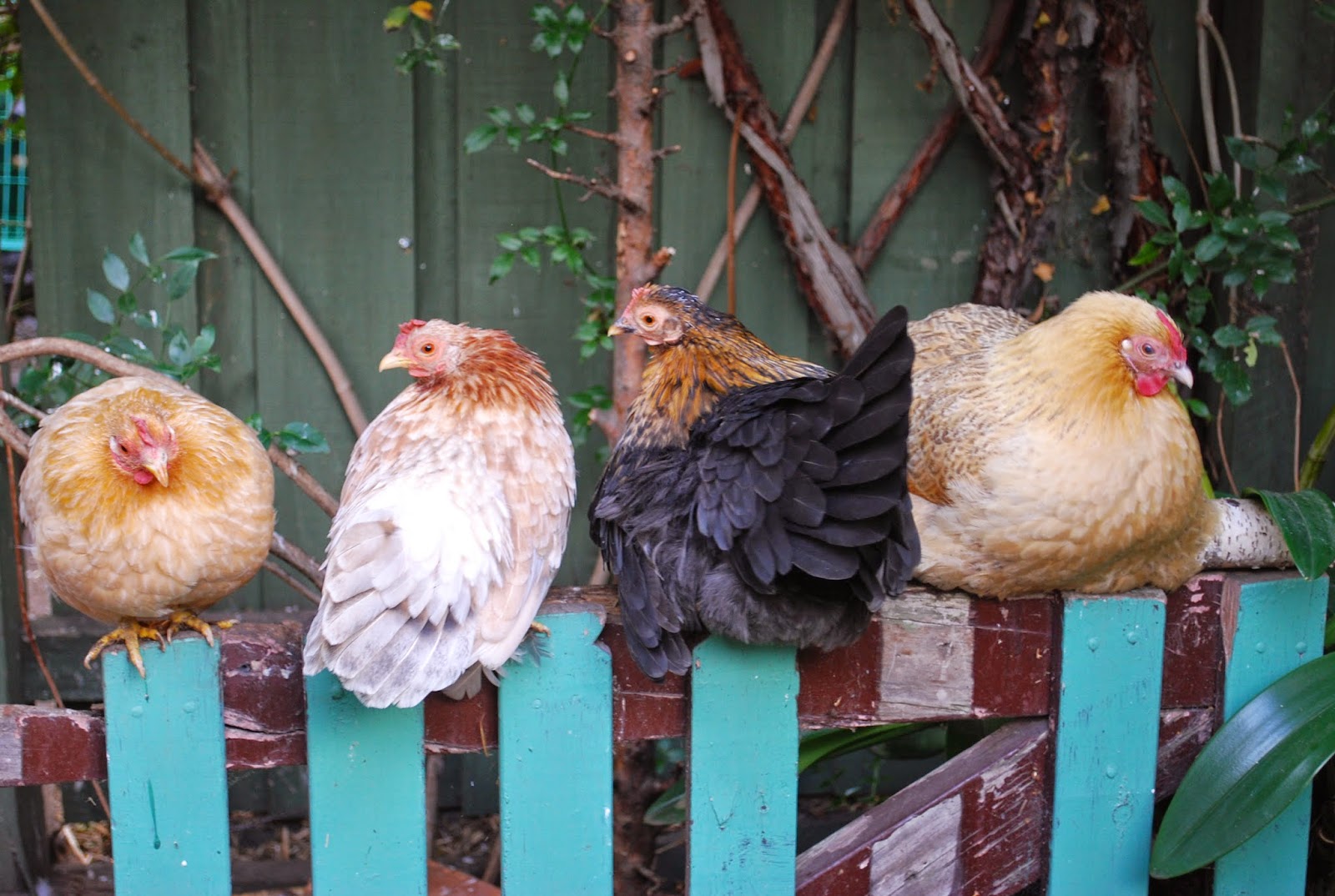
Three Jappies and a Bitzer sitting in a row
A little bird told me Freya, 13 year old owner of "only two types of chicken!" (woe how can this be?) was looking for some new chicken breeds to try so I wrote this post just for you Freya.

There are some gorgeous birds out there and it really depends if your focus is their decorative qualities, (living garden ornaments as my brother calls them :)) personality type or big egg production.

Here are a few of my favourites and that combine at least two if not three out of three!

The Japanese Bantam:


Tiny birds, small eggs (30g or so) and BIG personalities. They can become very tame, sitting on your lap or arm readily. They cope well living with larger birds because they fly well and they are pretty self confident.
Michael has noticed Mimi "shouldering" bigger birds away from treats in a very quiet determined way that is very amusing (that's Mimi in the pic below)

Jappeies have gorgeous tails that they fan out when strutting about which are nearly as big as them. They come in some gorgeous colours.

Even though their eggs are small they are actually quire useful for small baking jobs as there is no waste.

You can baste a pie for example without having to throw away unused egg.

Also handy if you need to halve a recipe (ever tried to halve an egg? Ever left unused egg in the fridge and forgotten it was there for a week or two? Yerk!).

Downside of Jappies? They do go clucky.. a lot. Best to have a clucky cage ready come Spring!

Below are four of my five Jappies in situ as I type.  Note: The rather stark looking clucky cage (a rabbit pen in fact ) is a temporary measure to help ease the birds out of their hormonal urge to "sit" on eggs and hatch chicks.  A futile exercise with infertile eggs.)


The next  photo gives you an idea of their size. You can literally hold them in your hand!

Mimi checks out my foot

Meditation time?

The Australorp


The only Australian breed of chook. Great calm temperament and friendly. Regular and frequent  layer of gorgeous eggs ranging from 40g (bantam) up to 90g. Vegemite our black Australorp laid a 90g and when I showed Michael he winced - "Is she alright?" he said with concern!.

Little Vegemite surveying the vegie garden

Her shiny feathers in the sun

Happy the Bantam Blue Australorp - Blue is a rare colour but becoming more popular

The Polish 

What can I say about Polish? Amazing! Curious and diligent diggers for bugs they are like puppies. Always under your feet and quite enjoy a cuddle (especially if purchased young). I've had Bibi go to sleep on my lap as I stroked her. They lay a good medium sized eggs 3-4 days a week and come in gorgeous colours. 
Bibi is a Bearded Polish (no not like a bearded lady - much prettier but a bit more lugubrious looking *rofl*) One thing to note is that Polish are a rare breed because they are less hardy than say Australorps. 

Bearded Partridge Polish
 BiBi and Jack were inseparable.

BiBi and Mangrove Jack 


Jack in the sun

Silver laced Polish - LuLu


So Freya these are three amazing breeds of chicken that I have in my garden. If you want to learn more about chickens I can highly recommend www.backyard poultry.com  (an Australian site) for more information and do feel free to email me with any questions! :)


Monday, 17 November 2014

The new pom-pom chicks

Check out the video link below where Little Sparrow below cannot get enough camera face time little lens hogger!


These wee gals came home with us from Harcourt last weekend and are enjoying their temporary quarters until big enough to roam with the adults.
This breed is a crested breed called a Polish. They are soooo curious and so friendly. Polish lay a medium sized egg of around 40g, three to four times a week. They don't go clucky and are a great backyard bird.

This is Lizzie - for Elizabeth Taylor and her 80's hairstyle and furs. Lizzie is a Frizzled Polish. Frizzles have a gene that causes their feathers to flick out instead of lay flat against their bodies. Many breeds come in a Frizzle version. Don't try and wipe the screen - I think those bits of straw were on my lens!


This shows their comparative size even though both are six weeks old. Sparrow is very very small but getting braver every day. She ate out of my hand and jumped on my shoulder and head the other day (though I think she surprised herself as much as me :) 

These gals were purchased from a lovely breeder up near Bendigo, Pam. She has a wide range of colours and ages and I would highly recommend her attention to detail and interest in the well being of her birds. These are her amazing breeding pens - designed AND built by her!
Check out Pam's Facebook page ...  Posh Poultry


Check out the video to see the third of the trio  who does not yet have a name - though I am thinking Marshmallow for her crest? Suggestions happily considered. (Marshmallow is a bit of a mouthful!.) .


Wednesday, 12 November 2014

The Festival of Gardens

The 13th Biennial Festival of Gardens in Castlemaine and District was held over Cup Week here in Victoria and it made our weekend away extra special. A big thank you to Lucy's Grandma Sally, a Castlemaine local,  for not only telling me about the festival but providing a hand marked catalogue of recommended garden visits!. The whole experience was a treat...despite the unusual bout of Spring heat last weekend.
 
Firstly we stayed in this amazing place for three nights - The Scout Hall -with the helpful host, Jacqueline's, solicitous but not intrusive attention.

Then we visited a range of outstanding gardens with a focus on sustainability. When I get the video I took of all the gardens happening here ( a tech glitch) I will add those as they give a much better appreciation of the breadth and variety of the gardens. In the meantime here are a few still shots.

Forest Edge

Forest Edge, owned by Jill and Graham Hisscock, was so breathtaking I could not take it all in at once. It is a series of many separate garden areas, each enclosed by charming weathered grey palings and always full of beneficial insect attracting plants such as seaside daises, yarrow and feverfew.

This is one of their (many) permie (aka permaculture) plantings to attract beneficial insects. I love it when function and form come together!

One of the enclosed gardens at Forest Edge

I especially loved that their chook run enclosed a  loquat tree and peach tree for shade and fruit for the chook! Orchards and chickens are a long time productive partnership as chickens eat the rotting fruit including the  bugs that would otherwise infest other fruit as well as fertilising the ground.

Chook Run
Extensive enclosed vegetable gardens and orchards surround the house.


The Berry Garden


The potting shed

Entrance to the orchard
 

Hedgehogs

This is Hedgehogs, an "eclectic 3 acre garden" , planted by Margot and Murray Rottem.   Margot was kind enough to give me a cutting of a plant I admired (the silvery one below spilling over the dry stone wall if anyone can identify it!).
 
This amazing garden was created from scratch over 18 years where previously there had been only rock. The rock does however make lovely dry stone walls throughout the garden, (and many gardens in Castlemaine).
 
Yellow Iris and mystery plant on steps leading up to their house
 
Yellow Iris borderd billabong

The impact of a dry climate can clearly be seen in areas where town water is not available and the bores only produce brackish water suitable for stock or firefighting, but this garden flourishes close to the house with tank water applied regularly.
 
The beautiful walled garden
 
Strawberries are grown in old guttering as the roots need only shallow beds and fall free of the dirt this way.
 
Strawberries growing in pieces of guttering

A major favourite - Mossbank - did not allow photographs but they do have a website for their B&B which gives some idea of their wonderful garden   Mossbamk - Castlemaine and mudbrick structures built by Judyand Peter Sherlock.

In between all this we visited with my adorable and "box of birds"  neice (insert doting Aunt's photo #1003)

In between all this I managed to get myself some utterly gorgeous new chooks with pom pom heads (Lucy loves these, smiling, head tilted and peering up under their crests to eyeball them with a very earnest and querying  "Hellllo?" ) ... but I will save the cute chick photos for another post or I won't get anything else done today! ( I spend enough time looking at the real thing as it is) .


Then Michael and I  headed home via Blackwood to get some plants, seeds and soil additives (organic of course) from St Erth. I would highly recommend joining the Diggers Club if you are interested in heirlooms, organics/sustainability.
 
 
We bought three different varieties of berry - an Autumn fruiting raspberry, Willamette, to get a crop when our existing raspberries are finished.


as well as a Tayberry and a Marionberry - two berries which I had never heard of.

Marionberry  - titled "the Cabernet of Blackberries!"

Tayberry - a Scottish developed berry named after the River Tay
 

We also bought three unusual Heirloom varieties of tomatos (photos in the next post), a space saver Cucumber for small gardens, a strawberry that is supposed to be extra delish (look out for that one Luce!), some rock dust for improving the soil, many seed packets including a coriander variety that does not bolt so readily,  some golden marjoram (so pretty!) and two apple trees which were a free gift as a member purchasing over a certain dollar amount. And some spring onion seedlings!
Golden Marjoram

 St Erth is a truly beautiful property if you ever get a chance to visit.

Main Entrance to St Erth, Blackwood


To top the weekend off we passed bags of horse manure for sale on the roadside heading through Newbury on our way home. "Stop the car!!"I yelped in excitement. "Horse poo for sale!"

As the car was already chockers with chooks and plants as well as our luggage and the Esky (which had transported all the food supplies for my elimination diet), sadly we could only fit 7x supermarket size bags of the bargain priced 50c a bag garden gold. :( I  would have taken 20 if I could!. Herbivore manure is so very good for replenishing tired depleted garden beds and adding to your compost bin.

Michael said he had never seen a woman so pleased by a load of poo and commented wryly that most other women had a similar reaction to diamonds.

Guess  I am a simple girl at heart ...I happily inhaled the 'fragrance' the rest of the way home,  dreaming about where I would plant what and my new chicks...
 

Monday, 25 August 2014

Styrofoam box planter or low fat chook food?

If you are like me and have run out of plant-able garden space here is another "up-cycling" suggestion.


I found this styro-foam box  literally by the side of the road two streets away in a council hard rubbish collection. I liked the size of it – good depth – so I decided to see if I could re-cycle it for seedling planting.


Friday, 22 August 2014

Introducing the chook that lays Blue Eggs

Dear Isabella, (Issy) our South American Araucana, is a funny chook, not just because of her crest obscuring her vision and so making it easy to sneak up on her, (handy when needing to administer medicines or weigh her) or the fact that her breed is the only chicken breed to lay a blue-green egg. (In some countries they are called "Easter Eggers"!).


No I think she is funny as firstly she loves her greens waaaaay more than the other chooks do.

How do I know this? 

She makes an excited chuckling sound in the back of her throat when she sees me carrying a bunch of greens. Then she tucks in like no-body's business, virtually  shoving the other chooks out of her way.

Friday, 15 August 2014

Confused about "Free Range"?


When you go to the supermarket it can be a real challenge to wade through all the different labelling. There are shelves upon shelves of eggs! I bumped into a gorgeous gal there the other week frowning a lot and asked if she was looking for true free range:  “Yeah - I don’t want the bullshit ones!”,  was her answer. Well – that sums it up for me! So I told her what I follow: Organic is definitely good if you can afford it as their requirements are strict and clear.

The short version of the story is to be absolutely sure your eggs are the kind of free range you would prefer to support. One way I have found is to look for these logos:

 
Producers bearing these logos have gone through really strict assessments to achieve this acknowledgement which is one of the reasons they are more expensive. If your 'free range' eggs are cheap, chances are they are not accredited. The longer version of the story has to do with producers "bending" the truth about their product being what most folk would call 'fair dinkum' free-range. The fact is  that the term “free range” gets bandied about almost as much as the terms “healthy” and “organic”. (I will have many posts on these latter topics also...)
Talk about “in the eye of the beholder!”.

In Australia the Free Range definition is encoded in the Animal Welfare Model Code of Practice, 2002 which states that birds should have access to an outdoor range. The code itself notes that the number of birds per hectare needs to be specified but as yet there is no specification about how much access   for how long or whether that outdoor range is bare dirt or edible pasture. The minimum stocking density is 1500 birds per hectare, though some producers opt for even lower density of 750 birds per hectare. The problem is, there is no maximum  so birds may have very differing conditions yet still be labelled free-range. The Australian Egg Corporation (AEC)  are reviewing this and were apparently at one point looking at having 20,000 birds per hectare endorsed. So far QLD is the only state to legislate that 1500 birds per hectare max is the standard  for product to be labelled as free range. Have I mentioned how much I love Queenslander's before? Yay the Sunshine State is all I can say!.

The welfare of the birds and the variables between free range, barn laid and cage in terms of bird health are complex. The AEC has produced an interesting document on their website which refutes claims that free range means happier birds. Free range birds are not as protected from predators and illness and pecking from other birds according to the publication. Here is a link so you can if interested explore this very explosive and emotional topic for yourself.
Your Eggs Your Choice

This site gives a good summary of the categories available and what they really mean in terms of the birds:  The Sustainable Org

One of the most trustworthy places to buy your eggs is

Monday, 11 August 2014

A fact about chickens you may not know...


Chickens need a certain amount of light to lay which is why in the shorter Winter days I will generally get less eggs.  This appears to be nature's way of giving the chicken's reproductive system a rest. A common commercial farm practice to ensure a year round supply of eggs is to provide artificial light sources to keep the girls laying.   This sadly means that after about two years their bodies seem give out and they develop reproductive disorders. This is why commercial farms 'move their battery hens on' at about 18 mths of age and often get "rescued" by backyard poultry keepers. .  

The photo above comes from a lady in the UK who was so concerned about the lack of feathers on the battery hens she "rescued"